
Body oil or cream after a shower?
Your skin feels soft after a shower, then tight again half an hour later. How does a cream differ from a few drops of oil? The answer starts with the water in the outer layer of your skin.
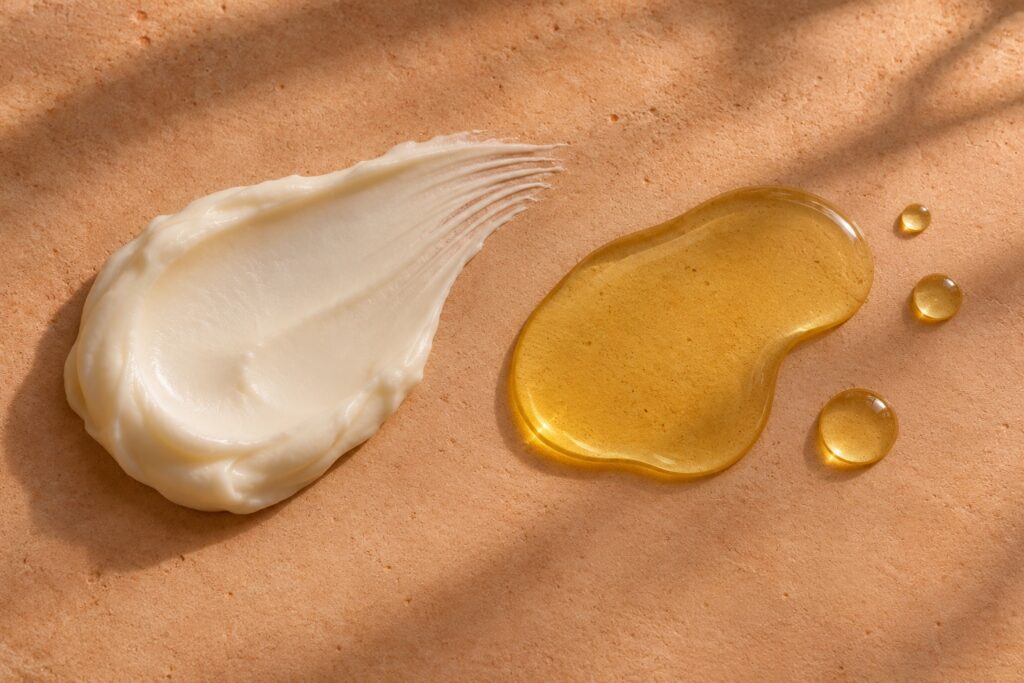
A thin layer of oil can give a dry shin a sheen in seconds. That tells you something about the texture you like. Whether your skin still feels less tight at the end of the day is a separate question. For persistently dry skin, a cream is a well-supported starting point. The studies below explain why, and what remains uncertain if you replace it with a pure plant oil. [1], [2]
What do researchers mean by hydration?
Two products can both be called moisturising and have been tested for different outcomes. A corneometer estimates the water content near the surface of the stratum corneum. Another instrument measures the water that evaporates through the skin, known as transepidermal water loss (TEWL). One measures water present, the other water escaping. To find out how comfortable skin feels, researchers have to ask the person. [1], [4]
What glycerin and petrolatum each contribute
Vaillant and colleagues compared four formulations on the forearms of 51 healthy volunteers with dry skin. They tested the base cream, the base with glycerin alone, the base with petrolatum alone and the full combination. Allocation was random and the study double-blind. They measured water content and evaporation over twelve hours. [1]
The combination reduced evaporation more than the base with glycerin alone and produced a higher measured water content than the base with petrolatum alone. The findings explain why both ingredients can be useful together. Only one cream was tested over one day, and several authors were affiliated with its manufacturer, Pierre Fabre. The findings apply most directly to that formulation. [1]
What changes after four weeks?
In another randomised, double-blind study, Shim and colleagues compared six formulations in 80 people with moderately to severely dry skin. Participants applied them to designated areas twice a day. After four weeks, clinical signs of dryness had improved from baseline with all six. None was a statistically convincing winner. The trial compared products with one another and had no untreated group. [2]
If your current cream feels comfortable, these results give little reason to switch just for one advertised ingredient. They also don’t tell us how a bottle of pure jojoba, castor or almond oil would compare. Those oils weren’t part of the trial. [2]
Reading a product claim. If a label says “hydrates for twelve hours”, look for what was measured, what the product was compared with and whether people could feel a difference. A change on an instrument and a change you notice on dry skin tell you different things.
Why an ingredient list can’t rank products
Parker and colleagues reviewed 22 studies of moisturisers for dry feet. Urea was the most studied ingredient, but methods differed and study quality was low to moderate. They could not recommend one ingredient over another. This tells us about the limits of research on dry feet and provides no ranking of facial oils. [3]
Eczema raises a different question. In a Cochrane review, a glycerin cream produced a slightly greater average improvement in clinician-rated severity than the control. The evidence for that particular outcome was strong, but the average difference fell below the threshold for clinical relevance. A real difference can still feel small. These findings specifically concern people with eczema. [4]
How to choose after a shower
- Your skin often feels dry and tight. Start with a cream you enjoy using regularly. After a shower is a convenient point in your routine. The studies cited do not establish a strict deadline between drying off and applying it. [1], [2]
- You mainly want a pleasant finish. Try a little body oil. Notice how easily it spreads and how your skin feels under clothing later. Those personal preferences can guide your choice.
- You’re unsure whether to add a product. Decide what you want to improve: flaking, tightness or simply the texture as you apply it. Changing one thing at a time helps you judge what works for you.
Scientific references
- Vaillant L. et al. (2020). Double-blind crossover study of glycerin and petrolatum in dry skin. Journal of Cosmetic Dermatology.
- Shim J.H. et al. (2016). Randomised double-blind comparison of six formulations for xerosis. Journal of the European Academy of Dermatology and Venereology.
- Parker J., Scharfbillig R. and Jones S. (2017). Systematic review of moisturisers for dry feet. Journal of Foot and Ankle Research.
- Van Zuuren E.J. et al. (2017). Systematic review of moisturisers for eczema, including certainty of evidence for individual outcomes. Cochrane Database of Systematic Reviews.