
Why do some oils feel thicker than others?
Jojoba, argan and castor oil can sit on the same shelf yet flow quite differently over your fingers. How much of that can their chemistry explain?
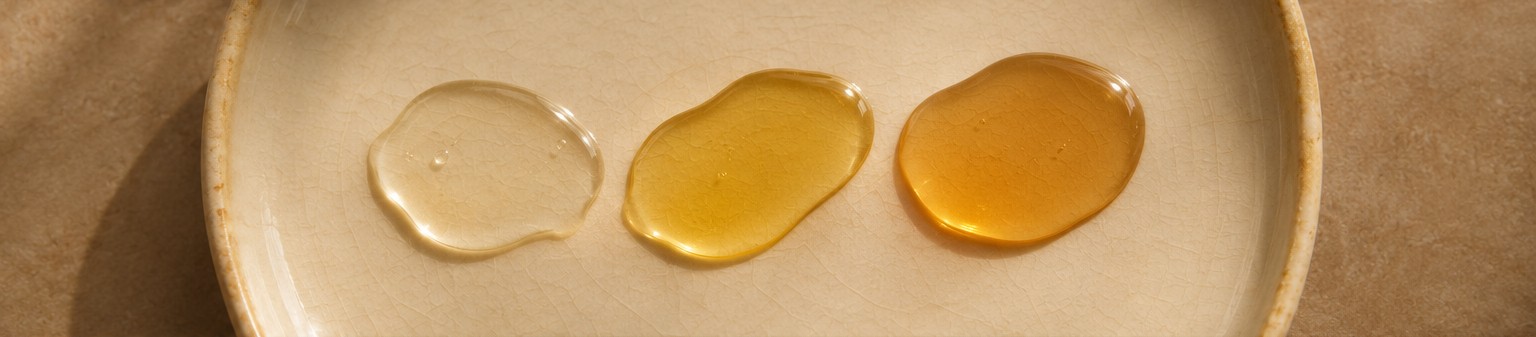
Tilt a teaspoon of jojoba oil, then do the same with castor oil. Watch how slowly the latter creeps towards the edge. The term for resistance to flow is viscosity. Viscosity can be measured reliably. To find which texture you like on your skin you also need your fingertips. [1]
Castor oil and the attraction between molecules
Ricinoleic acid accounts for much of the fatty acid content of castor oil, largely bound to glycerol. Partway along its carbon chain is a hydroxyl group: an oxygen atom bonded to hydrogen. These groups allow neighbouring molecules to form temporary hydrogen bonds. Together these interactions resist flow, helping explain castor oil’s thickness compared with many other plant oils. [2]
You notice it in the first stroke. A drop that stays in place takes more movement to cover the same area. That can be handy for a few hair ends and less appealing for an entire lower leg. Where you want to apply it matters more than a ranking of the ‘best’ oils.
Jojoba is a liquid wax
Wax may bring a solid candle to mind. In jojoba it describes the molecular structure. The seeds mainly contain wax esters, in which a long-chain fatty acid and a long-chain fatty alcohol are linked. This differs from the triglycerides that dominate many plant oils. Jojoba is liquid at ordinary room temperature. [3]
Ghannam and colleagues used a viscometer and a rheometer to compare jojoba, castor and olive oils with glycerin between 10 and 75 °C. As the oils warmed, viscosity fell. Jojoba behaved more like olive oil, while castor oil behaved distinctly differently. Compare two bottles when both are at the same temperature. [1]
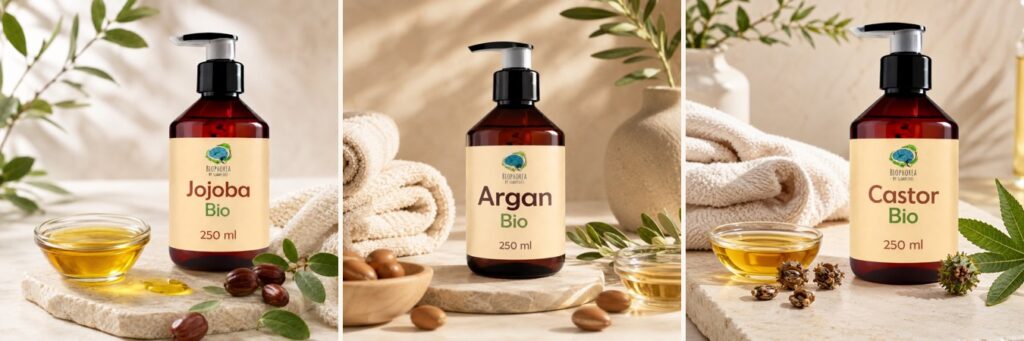
Where does argan oil fit?
Argan oil consists mainly of triglycerides, with oleic and linoleic acids as its principal fatty acids. Its profile differs from jojoba and castor. Ghannam’s flow study did not include argan oil, so those results can’t place it on a precise light-to-heavy scale. Its composition is well described. How easily a particular argan oil spreads is something you can compare for yourself. [1], [4]
Compare two oils side by side
- Leave the bottles in the same room. Use two clean teaspoons and similar amounts. A pump or dropper can dispense a different volume with each design.
- Tilt both spoons together. Watch which oil reaches the edge first. You now have a simple visual comparison.
- Compare how they feel too. Spread a little of each on equally sized areas of intact skin, such as the backs of your hands. Notice how they spread, then check the shine and any remaining film a few minutes later.
These observations needn’t agree. An oil can run quickly off a spoon and leave a lasting film on skin. In everyday use, ‘absorbs quickly’ often means you can barely feel the film. How deeply components penetrate requires different testing. For your own routine, it may be simpler to ask whether you can comfortably hold a book or roll your sleeve back down afterwards.
Scientific references
- Ghannam M.T. et al. (2023). Experimental flow study of jojoba, castor and olive oils and glycerin. International Journal of Thermofluids.
- McKeon T.A. (2016). Ricinoleic acid chemistry and castor oil viscosity. Industrial Oil Crops, AOCS Press.
- Gad H.A. et al. (2021). Review of jojoba’s chemical composition and principal wax esters. Full publication.
- Gharby S. and Charrouf Z. (2022). Review of argan oil composition, extraction and quality control. Frontiers in Nutrition.